Operating Intelligence
AI Consultant for Small Business: What Good Looks Like
An AI consultant for small business is not valuable because they know a secret model that nobody else can access. They are valuable when they can see how the business actually works, identify where judgement is being trapped in manual effort, and build a system that gives that judgement back to the operator.
That matters because small businesses do not fail at AI because the tools are weak. They fail because the tool is added to the same scattered inboxes, spreadsheets, notes, handoffs, and half-remembered decisions. The result looks modern, but the work underneath still leaks.
What should an AI consultant actually do first?
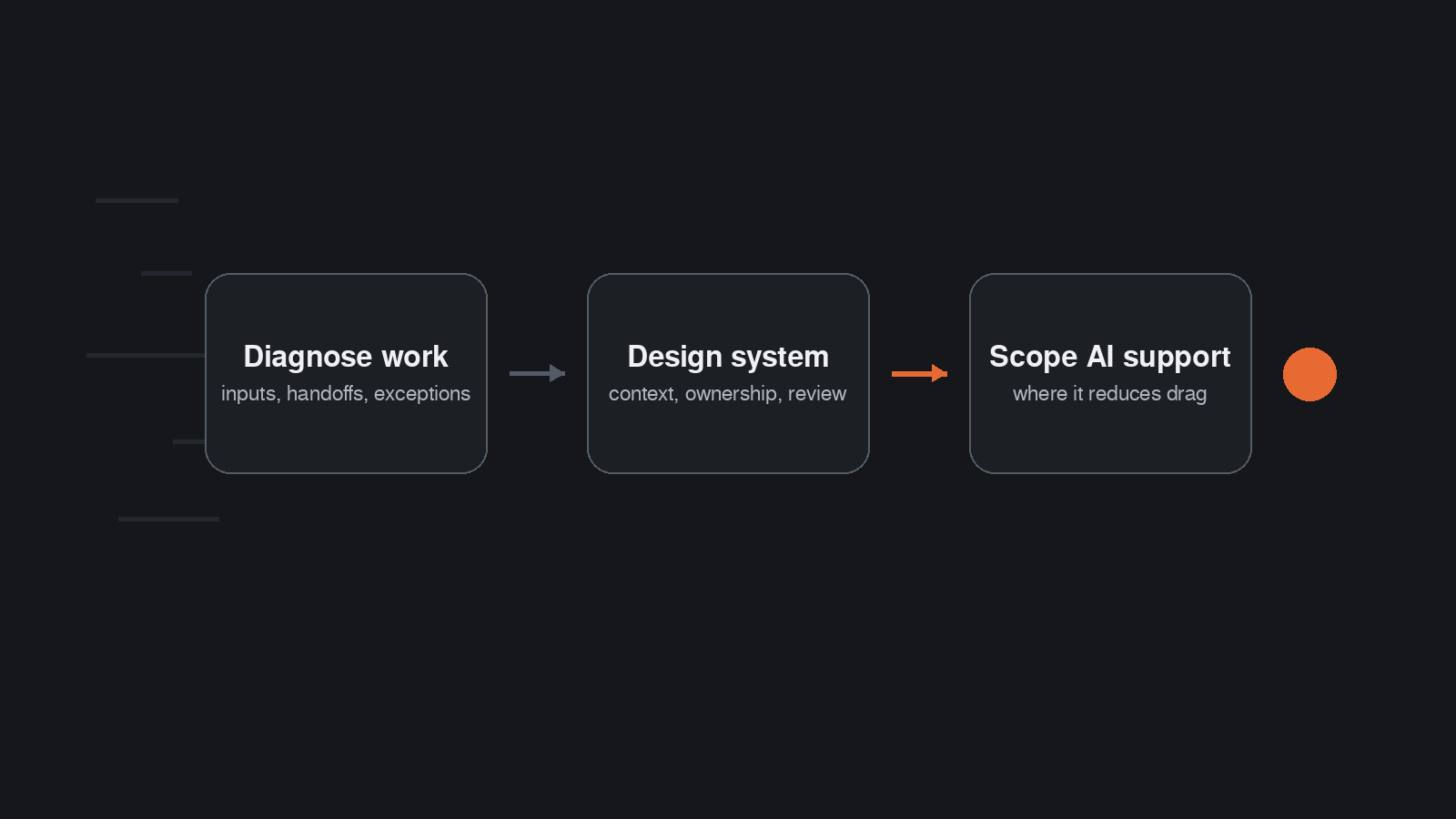
A good AI consultant should begin by mapping the work before choosing the tool. They should ask where time disappears, which decisions repeat, what context people keep rebuilding, and where follow-up slips after a meeting or client conversation.
The first useful output is not a chatbot, just as systemising a small business starts with making the work visible before adding more tools. It is a clear view of the business system: inputs, judgement points, handoffs, records, exceptions, and the moments where a human still needs to decide. Once that is visible, AI can be placed where it reduces drag instead of adding another place to check.
Tip
Author's tip: If the first conversation is mostly about which model to use, slow down. The harder and more valuable question is which part of the business needs to remember, route, or prepare better.
This is why context is the real infrastructure is still the useful starting point. The model can answer, but the surrounding context decides whether the answer helps the work move.
Where do most AI consulting engagements go wrong?
Most engagements go wrong when AI is bolted onto how the business already works. A consultant automates a messy process, adds a summariser to a meeting, connects a few apps, and calls it transformation. The same trap appears when a business tries to connect all its tools without deciding what context should move between them. The business gets novelty, but not much relief.
The research pattern is consistent. Reports on small-business AI failures point to unclear objectives, poor data readiness, weak change management, and little ongoing ownership. Some Australian SMB commentary puts the successful minority down to better surrounding work, not better AI. One implementation playbook reports that external AI specialists succeeded 67% of the time, while purely internal builds succeeded about one-third as often. Another warns that pilots with adoption below 30% by week eight should be stopped or redesigned. Drift can also reduce accuracy by 10% to 15% over six months if nobody monitors it.
Engagement type comparison
- Tactical tool install: what it starts with: A tool or model choice; what the business gets: A faster version of one task; risk: The mess stays in place.
- Workflow automation: what it starts with: One measured bottleneck; what the business gets: Less manual handling; risk: It may not change judgement quality.
- Systemic engagement: what it starts with: Context, judgement, adoption, and ownership; what the business gets: A business that remembers and routes work better; risk: Requires clearer thinking upfront.
The tactical work is not always wrong. Sometimes a firm needs one workflow fixed. The problem is pretending that a small automation is the same as building operating intelligence.
Is the AI model really the difference?
The AI model is rarely the durable difference. Most businesses have access to similar frontier models, similar assistants, and similar automation platforms. The difference is what gets built around them: memory, integrations, prompts grounded in the business, review points, escalation rules, and the habit of using the output.
This is especially important for smaller teams. A big company can absorb an abandoned pilot. A small business feels the waste immediately. If a system saves two hours once but creates another inbox forever, it has not improved the operating model.
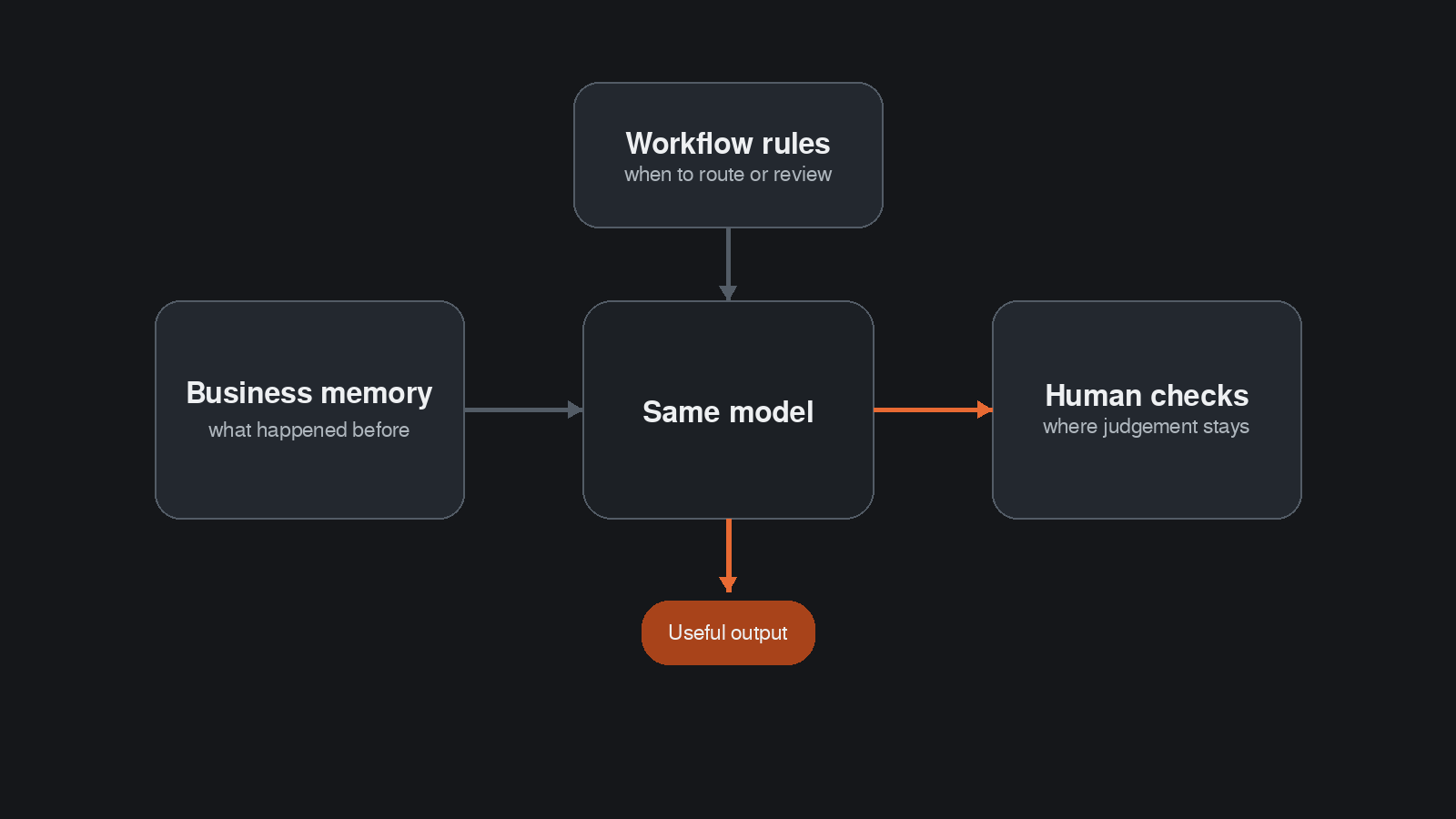
That is also why what Clearly remembers is a useful lens. The question is not only what AI can generate. It is what the business can retain, connect, and bring back at the right moment.
What changes when the operator gets their judgement back?
When the operator gets their judgement back, AI stops feeling like another tool to manage and starts removing the orientation tax from the day. The owner, partner, or senior operator no longer has to reconstruct what happened before deciding what to do next.
That changes the commercial value of the engagement. The goal is not to replace the operator. It is to protect their attention for the work where experience matters: reading a client situation, choosing the right next move, spotting risk, and knowing when not to automate.
In practical terms, the system should make recurring work easier without flattening the judgement inside it, which is also the practical path to scaling without hiring more staff. It might prepare the client context before a call, draft a follow-up based on the actual conversation, route an exception to the right person, or surface a prior decision before it is accidentally reversed. That is why consistent client follow-up is a useful test case for whether the system actually remembers.
Warning
Please note: Automation is only useful when the business can still see who owns the decision. If the system hides judgement, it will eventually create risk, even when it saves time at first.
How can you tell a systemic engagement from a tactical one?
A systemic AI engagement has a few visible signs. It names the business outcome before the tool. It maps the current workflow as it really operates, not as the SOP says it should operate. It defines where humans check the work and measures adoption, not just output. It also plans for drift, because AI performance can degrade quietly over time.
A tactical engagement usually stops at delivery: here is the bot, here is the automation, here is the prompt pack. A systemic engagement keeps asking whether the work is now easier to run.
Use this checklist before hiring an AI consultant for small business:
- Can they explain the workflow they are changing before they mention the tool?
- Do they ask what context the business keeps losing?
- Do they define success and kill criteria before building?
- Do they show where human judgement stays in control?
- Do they plan training, handover, and ongoing review?
Build AI around the work that matters If your business is ready to move beyond experiments, Catalyst Systems can help you design the system around the model. Book a conversation and we will start with the work, not the tool.
Your next step
The right AI consultant for a small business does not sell a magic layer over the old way of working. They help the business see where context is lost, where judgement is trapped, and where AI can remove drag without removing control.
If you are already using AI in fragments, start with the moment that keeps costing you time. Then build the memory, routing, and review around it. That is where the return begins.