AI Consulting
Opening a Second Accounting Office? Move the Review First

A second office works for an accounting practice when the principal's review judgement and client context reach it in writing, rather than in the principal's car. The client files, the practice management software and the templates move on the first day; the reasons behind them stay with whoever made the decisions.
Those reasons are what clients pay for. Which client needs a phone call before lodgement, why a family trust was set up the way it was, why one fee sits outside the schedule: none of it sits in the workpapers, and each one changes what a reviewer should check.
If you are weighing a second office and every hard question in the first one still ends at your desk, this piece is for you. It covers what stays behind, what the Tax Practitioners Board expects of supervision across two sites, how to tier partner review, and what to settle before you sign a lease.
What moves to a second office, and what stays with the principal?
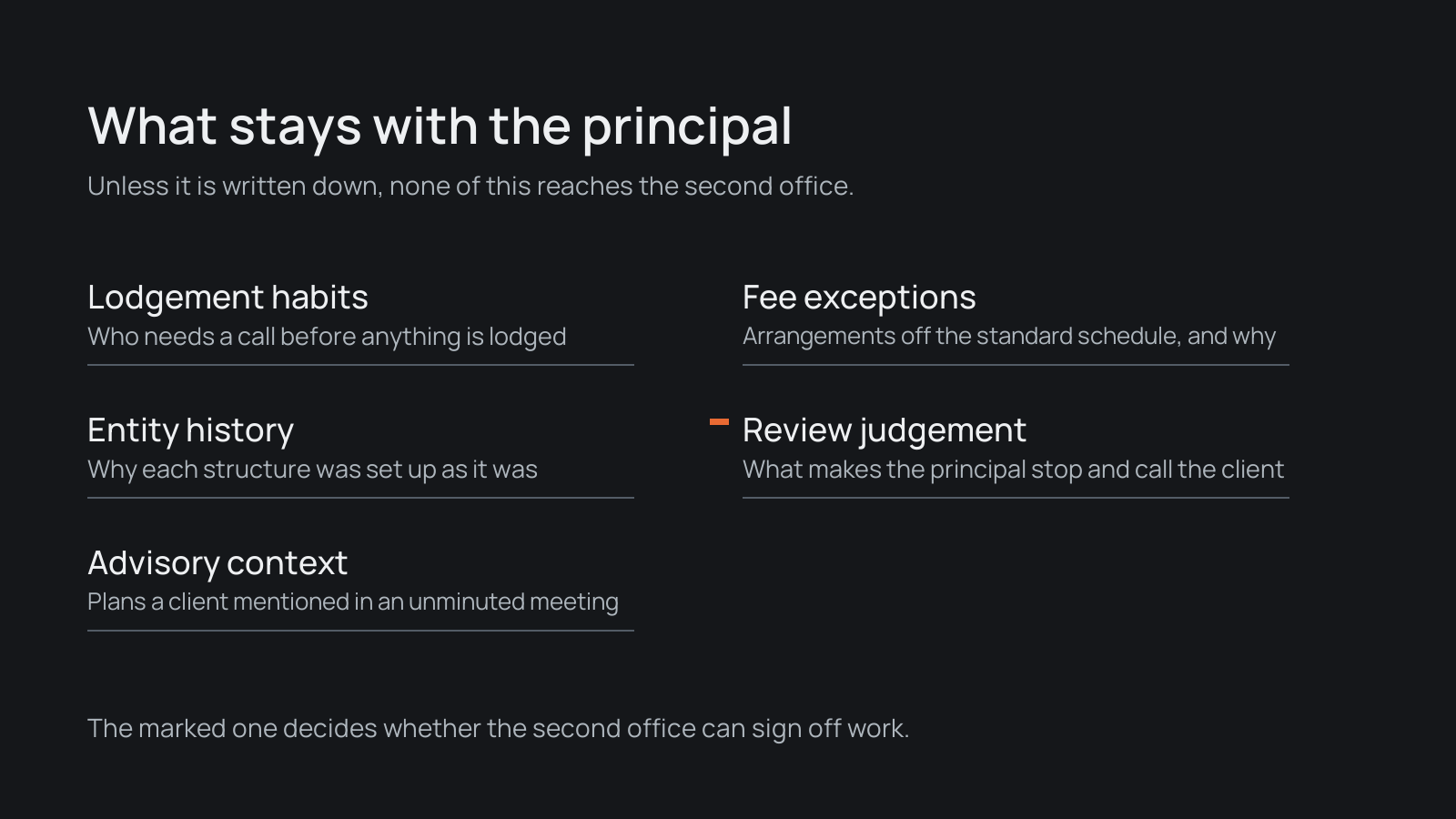
Everything already written down moves easily, and everything the principal carries in their head stays put. The client list, the practice management system, engagement letters and workpapers open in a new office on the first morning. What stays behind is the context that tells a reviewer whether the work is right for this client:
- Lodgement habits: which clients need a call before anything is lodged, and which ones never read an email.
- Entity history: why a structure was set up as it was, what was decided at the time, and what would make it worth revisiting.
- Advisory context: what the client said about selling, retiring or bringing in a family member, usually in a meeting nobody minuted.
- Fee exceptions: the arrangements that differ from the standard schedule, and the reason each was agreed.
- Review judgement: what the principal looks for when signing off a return, and what makes them stop and call the client.
Researchers call this tacit knowledge. In a 2001 paper in Family Business Review, Cabrera-Suárez, De Saá-Pérez and García-Almeida described it as knowledge embedded in the context where it was developed, often in the founder, so that "its transmission is very difficult and possible only by its application in practice through a slow and costly process." For a practice, that means the handover takes months of working side by side, so it is better started before the second office opens than after the first client complains.
What do the TPB supervision rules mean for a second office?
A registered tax or BAS agent has to supervise the work done on its behalf wherever that work happens, so a second office is a supervision question as well as a growth one. The Tax Practitioners Board's guidance on supervision, competency and quality management, last updated in April 2026, sets out three points that bite when staff sit in another location.
- Sufficient number. A company or partnership agent must have enough registered individuals to deliver services competently and to carry out supervisory arrangements. There is no formula; the TPB weighs client numbers, complexity, staff experience and your "escalation procedures".
- Substantial oversight. The TPB says supervisors do not have to monitor all work, but must provide "a substantial degree of oversight", meaning considerable involvement rather than "simply checking from time to time".
- Remote arrangements. Where supervisor and staff are in different locations, the TPB lists what to consider, including how often you are in contact, how documents are reviewed and feedback given, how files are shared, and whether reviews can be carried out remotely.
The signature carries weight too. Under the Tax Agent Services Act 2009, signing a declaration about a client that was not prepared under your supervision and control is a civil penalty breach, with a maximum of 1,250 penalty units ($412,500) for a partnership or company agent, according to the TPB's guidance. The TPB strongly recommends a written supervisory plan setting out who supervises whom and how.
Quality management sits alongside this. APES 320, effective from 1 January 2023, requires firms that provide non-assurance services to establish policies and procedures across seven elements, including engagement performance, information and communication, and monitoring and remediation. A second office is where an undocumented system shows its gaps first, because the people in it cannot lean across the desk and ask.
Tip
Please note: this is general information, not professional advice. Before changing who supervises or signs off which work, read TPB(GS) 53/2024 on the TPB website and check the requirements of your professional body.
Why does partner review end up on one desk?
Partner review collects on the principal's desk because the principal is the only person who knows what to look for. When the second office opens, its work joins the same queue, and turnaround slows in both offices at once.
The fix starts with writing down the review judgement itself. List what you check on each job type, what triggers a call to the client, and what you would never let go out without seeing. That written list is also the backbone of the supervisory plan the TPB recommends.
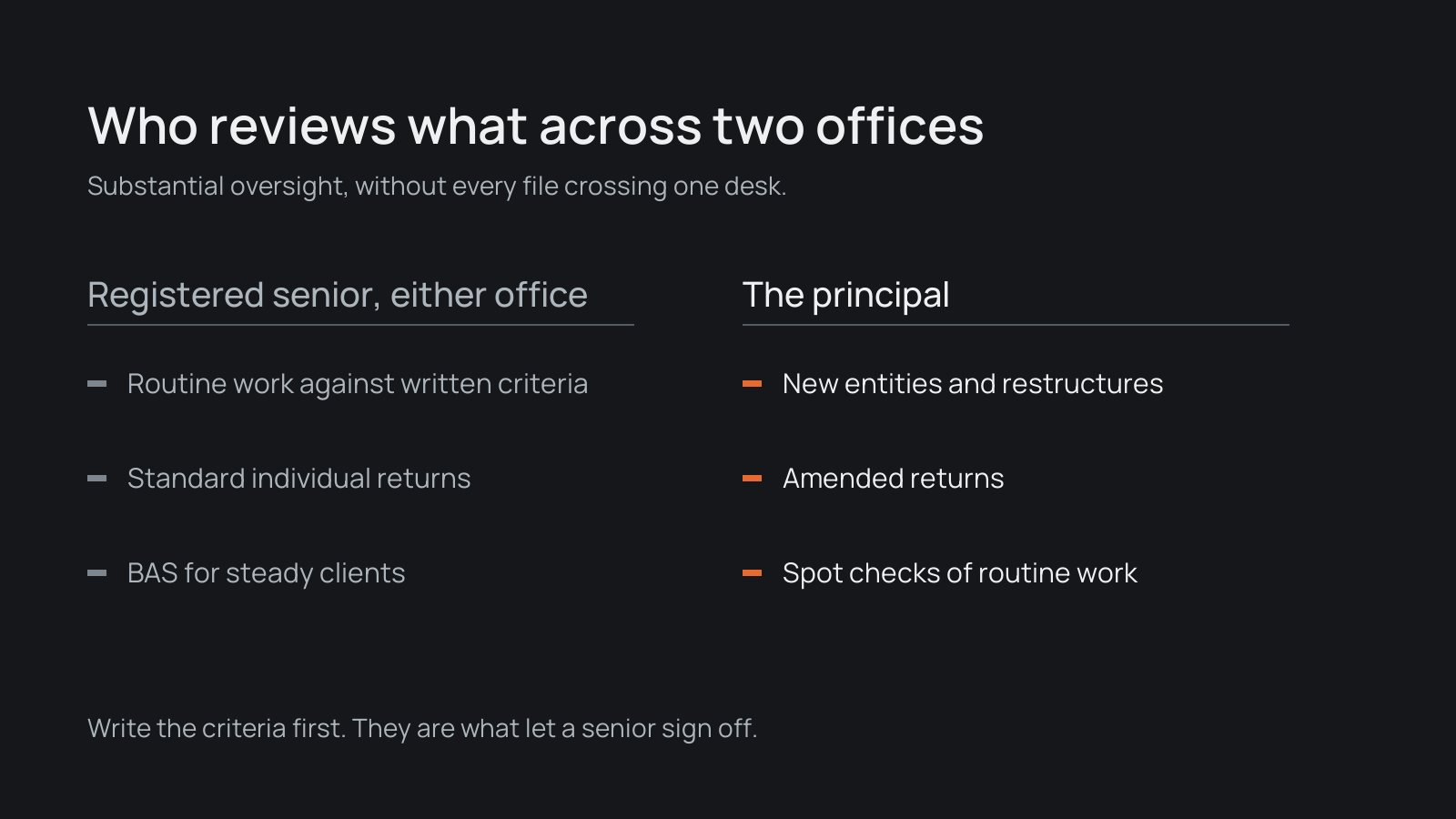
With the list in hand, you can set review tiers:
- Routine work (standard individual returns, BAS for steady clients) is reviewed by a registered senior in either office against the written criteria.
- Defined exceptions (new entities, restructures, amended returns, anything outside the written criteria) come to you.
- Spot checks of the routine tier, on a set rhythm, so oversight stays substantial without every file crossing your desk.
A delegation of authority matrix is a simple way to record who can approve what, within which limits, so both offices apply the same tiers.
Who runs the second office, and what do they need from you?
The person running the second office needs the authority to decide things there and the client context to decide them well. A title without either turns the office lead into a messenger who checks everything with you.
Experience gathered in one location does little for another from a distance. Kalnins and Mayer studied the survival of Texan pizza restaurants and found units benefited from their owner's local experience "but not from distantly gained experience", which they said showed "the continued importance of local experience, even among the most codified and standardized business organizations." A pizza chain is a long way from an accounting practice, so treat this as a pattern rather than proof: your experience in the first office helps the second only when it is there, in a person who has worked beside you or in a record they can use.
Promote someone who knows the clients, or hire someone who knows how to run an office. Either way, give them the client history in writing, a registered supervisor they can reach, and a written list of what they decide without asking.
Should the second office copy the first exactly?
Copy how the first office reviews, records and follows up work, and adapt what depends on local clients. Szulanski and Winter, writing in Harvard Business Review in 2002, argued that businesses often fail when they try to reproduce a best practice, partly because in-house experts do not truly know why it worked in the first place.
In a practice, the principal is that expert. You can only copy what you can see, and if the way your first office handles a difficult client lives in your head, the second office has nothing to copy. Two habits keep the offices from drifting into two ways of working:
- Reasons in the client file. The reason behind a decision goes next to the work, where both offices find it, and a decision log holds the practice-wide calls.
- Answer into the record. When someone in either office asks a question you have answered before, update the record first, then point them to it.
Software helps if the knowledge is in it. Our guide to AI for accountants covers where tools can carry routine work and where human review stays in charge. At Catalyst Systems, this is the work we build for: a system that captures the reasons as the work happens, so the second office has something to copy and the principal has fewer questions to answer twice.
What should be in place before you sign the lease?
Before committing to a second office, check whether the first one can run without you. If it cannot manage two weeks with you away, a second office splits your time between two offices that both need you.
- Written review criteria for the main job types, so a registered senior can sign off routine work.
- A supervisory plan naming who supervises which staff in each office, how files are reviewed, and how often you are in contact.
- Client notes for your largest clients that record the reasons behind how each is handled.
- A named office lead with a written list of the decisions they make without you.
- One shared client record and decision log that both offices work from.
- A test period where the first office runs while you are reachable but not consulted by default.
The two-week question is a simple way to run that test: what breaks while you are away shows what a second office would break too. Buying a practice instead raises the same problem with another principal's knowledge, and our client handover template sets out what to capture from the seller.
Tip
Tip: for a fortnight, write down every question about a client that reaches you from staff. Each one points to context a second office would also need, and to a line your supervisory plan should cover.
Your best people carry what the organisation can't. Start by writing down what you carry.
Frequently asked
- When is an accounting practice ready to open a second office?
- A practice is closer to ready when the first office can run for two weeks without the principal, routine work can be signed off by a registered senior against written criteria, and client notes record why things are done as well as what was done. If staff still route every client question to the principal, a second office adds to that load.
- Can a partner supervise staff in another office under TPB rules?
- Yes. The Tax Practitioners Board recognises remote supervisory arrangements where supervisor and staff are in different locations. It expects a substantial degree of oversight and lists what to consider, such as contact frequency, how documents are reviewed and how files are shared, and strongly recommends a written supervisory plan.
- How does a principal review work across two offices?
- Write down what you check on each job type and what makes you call a client, then set tiers so routine work is reviewed by a registered senior in either office and defined exceptions come to you. Add regular spot checks so oversight stays substantial, and confirm the arrangement with your professional body.
- Is buying an accounting practice easier than opening a second office?
- Buying gives you clients and staff on day one, but the client context belongs to the outgoing principal and leaves with them unless it is handed over. Opening an office means moving your own context instead. In both cases the handover of reasons, not files, decides how well clients stay.