AI Consulting
Client Handover Template: Transfer the Relationship, Not Just the Task List

A client asks the colleague who has just taken over their account about a discount the previous account lead promised, and nobody else knew it had been offered. A client handover template prevents that moment by transferring the relationship along with the task list, so the receiving colleague can continue the work without calling the person who left.
The usual handover ends when the outgoing person finishes a document. The task list is current, the contacts are listed and the files are shared. Yet the promises, preferences and half-settled questions that shape the relationship are still in one person's inbox and memory. Those are the gaps the client notices first.
If you have inherited an account and spent the first month finding out what was agreed, this is for you. Below is a template you can copy, a way to separate what is confirmed from what is assumed, and a test that tells you when the handover is finished.
What does a client handover need to preserve?
A client handover needs to preserve five things: the current work, the promises made, the client's preferences, the unresolved issues and the history that explains them. A task list covers only the first.
- Current work: what is in progress, what stage it is at and when the next part is due.
- Promises: anything said to the client that the business now has to honour, including informal ones made on a call or in a quick reply.
- Preferences: how the client likes to be contacted, who on their side makes decisions, and what has frustrated them before.
- Unresolved issues: complaints, disputes or questions that were raised and never closed.
- Relevant history: the events that explain why the account works the way it does, such as an old mistake that led to an extra check.
Promises and preferences go missing most often, because they rarely sit in the job system. They sit in sent emails, call notes and the outgoing person's head, which is why client follow-up tends to slip in the weeks after an account changes hands. It is the same pattern behind key person risk: the business depends on what one person remembers, and the dependency surfaces the day that person moves on.
What should a client handover template contain?
A client handover template should record six things: the agreement, the commitments, the decisions, the next action, access and ownership. Each field answers a question the receiving colleague would otherwise have to ask the person who left, and a seventh field holds the questions nobody can answer yet.
The client handover template
Copy these fields into the client's file, one handover per client:
- Agreement: [What the client is paying for, with a link to the signed proposal, contract or engagement letter. Note anything you deliver that sits outside it.]
- Commitments: [Every promise to the client that is still open: what it is, who made it, when, and a link to where it was made.]
- Decisions: [Choices made with or about this client that the next person must respect, each with its reason.]
- Next action: [The next piece of work the client is expecting, when it is due and what done looks like to them.]
- Access: [Every system, folder and portal the work needs, and who grants access to each one.]
- Ownership: [Who owns the relationship from today, who is the interim owner of anything unresolved, and the date the outgoing person stops being the contact.]
- Open questions: [Anything the outgoing person is unsure of, each with a name and a date for settling it.]
Tip
Tip: build the commitments field from the sent folder, not from memory. Search the last few months of emails to the client for words such as "will", "promise" and "by the end of", and you are likely to find commitments nobody thought to list.
How do you separate confirmed facts from assumptions?
A fact in a client handover is confirmed when it links to evidence the receiving colleague can open: the contract, the email, the meeting note or the invoice. Anything without a link is an assumption, however confident the outgoing person is.
Mark each line as one or the other. "The client agreed to quarterly reporting", with a link to the client's email, is confirmed. "I think they are happy to move the review to February" is an assumption, and it belongs in the open questions field with a name beside it: who will ask the client, and by when.
The distinction matters because a reader cannot tell the two apart from the wording. A confident sentence from someone who has run the account for years reads as fact. In its 2017 alert on hand-off communication, the Joint Commission, which accredits hospitals in the United States, described the same problem in clinical handovers: "expectations can be out of balance between the sender of the information and the receiver." Links close part of that gap, and a written list of open questions closes the rest.
What must the receiving colleague check?
Before accepting a client handover, the receiving colleague must check four things: understanding, access, authority and readiness for the next client interaction.
- Understanding: can they explain, in their own words, what the client pays for, what has been promised and what the client cares about most?
- Access: can they open every system, folder and portal the next piece of work needs, without borrowing someone else's login?
- Authority: do they know what they can approve on their own, such as a revised due date, and who decides anything larger?
- Readiness: could they run the next call with the client tomorrow, knowing the open issues and the client's preferences?
Hospitals have studied this step closely, because a detail lost when one doctor hands a patient to the next can cause harm. The I-PASS handover method ends with "synthesis by receiver", in which the person taking over summarises what they heard, asks questions and restates the key actions. In a 2014 study across nine hospitals and 10,740 patient admissions, medical errors fell by 23 percent after the program was introduced and preventable adverse events by 30 percent. Spoken handovers took about the same time as before, 2.5 minutes per patient against 2.4.
A client account is not a hospital ward, but the principle carries across: the receiver shows they understand, and the sender does not assume it.
What happens when the client handover is incomplete?
When a client handover is incomplete, an interim owner answers for everything unresolved, and each open item is assigned to a named person with a date. Few handovers close every item, and that is manageable as long as each one has a name next to it.
The interim owner is usually the outgoing person if they are still in the business, or their manager if they have left. The job is narrow: chase the open questions, confirm the unconfirmed facts and pass each item across once it is settled.
Write each unresolved item with three parts: the item, its owner and the date it will be settled. "Confirm with the client whether the promised discount still applies: account lead, before the next invoice" is an assignment. "Discount to be confirmed" is a note nobody owns, and it tends to be the one the client raises first.
When the outgoing person is the owner, the same template applies, with far more in the decisions field. Our guide to reducing founder dependency covers that case. The same assignment habit keeps work moving when someone is on leave rather than leaving, which is the job of a business continuity plan.
Test the next piece of work before signing off
A client handover is complete when the receiving colleague has done the next piece of work for the client without asking the outgoing person anything. Checking that is the continuation test, and it replaces the "document received" tick that handover checklists usually end with.
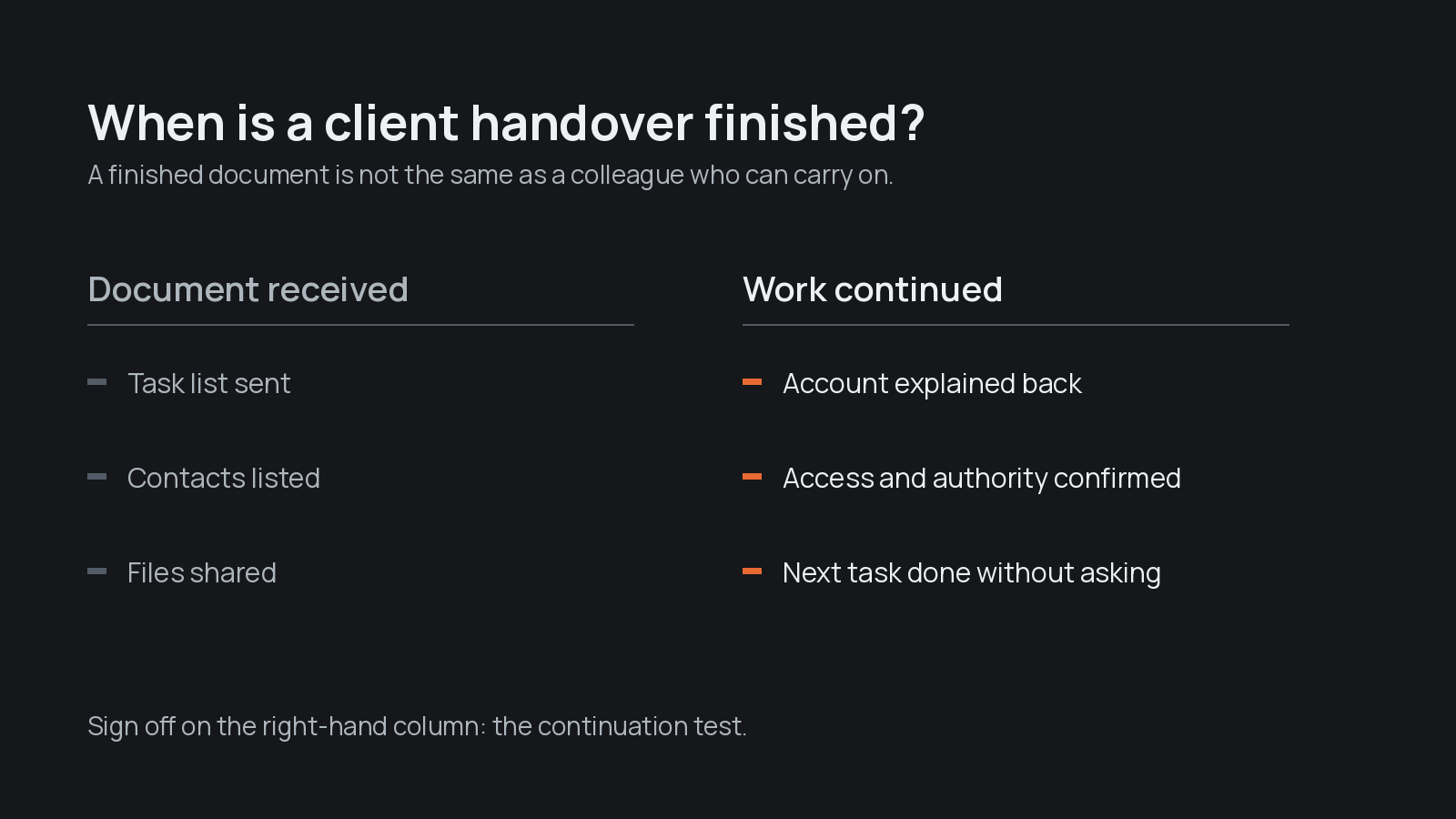
The continuation test is a handover check in which the receiving colleague prepares or delivers the next real piece of client work from the handover alone, while the outgoing person can still be reached. Run it in three steps:
- Pick the next real task, such as the monthly report, the next meeting or a reply to an open query.
- The receiving colleague does it from the handover alone, and writes down every question they would have asked the person who left.
- Each question goes back into the handover as a fix, answered by the outgoing person while they are still around.
If the list of questions is empty, sign the handover off. If it is long, the handover is not finished, however complete the document looks. It is the client-level version of what we call the two-weeks test: what breaks if you take two weeks off?
A handover document is still written once, in someone's final week, largely from memory. Clearly, the product we build at Catalyst Systems, captures what happens with each client as it happens, connects it to what the business already knows and gives the next person the context to make good judgements. The commitments and decisions are recorded when they are made, so the next handover starts from the record.
Pick the account that lives most in one person's head, fill in the template for it, and run the continuation test on the next piece of work. Then you can sign it off.
Frequently asked
- What is the difference between a client handover and a task handover?
- A task handover passes on the work in progress: what is due, where the files are and what comes next. A client handover also passes on the relationship: the promises made, the client's preferences, the open issues and the authority to act. The receiving colleague needs both to continue without calling the person who left.
- Who should write the client handover?
- The outgoing person writes the first draft, because they hold the context. The receiving colleague then checks it, adds every question the document cannot answer, and signs off only after the continuation test. A manager or the owner should confirm the ownership and authority details.
- How long should a client handover take?
- Long enough for the receiving colleague to complete one real piece of work for the client while the outgoing person can still answer questions. For a simple account that may be a single task; for a complex one it can mean several weeks of overlap. Set the handover by the next piece of work, not by the calendar.
- What if the person who held the account has already left?
- Name an interim owner, usually their manager, and rebuild the handover from evidence: the agreement, sent emails, invoices and meeting notes. Mark anything you cannot confirm as an open question and, where it matters, ask the client directly. A direct question is better than a promise quietly dropped.