AI Consulting
How to Tell Whether AI Is Actually Saving Your Business Work
AI can draft a client update quickly while leaving you to find the records, check the details and repair the answer. Count all that work before deciding whether the business is better off.
To measure AI results, compare the total effort needed to finish acceptable work before and after AI, then account for setup and ongoing costs. Keep saved time separate from cash savings and extra capacity. For a lean Australian team, fewer interruptions and less evening checking can matter, even when wages stay unchanged.
We use the following worksheet to make that distinction explicit. It helps you judge the work after setup, rather than the speed of a demonstration.
Establish a baseline for finished work
A useful baseline records the time and quality of completed work using your current process. Choose one repeatable task, such as preparing a client update, and define what counts as finished.
Include finding information, preparing the draft, reviewing it, correcting mistakes and sending or filing the approved result. Add every person's time, including the founder's final check. Our guide to business process mapping helps expose those hidden steps.
Record ordinary and difficult jobs across a representative working period. Note workload, complexity, rejected drafts, errors and delays. Compare similar jobs during the AI trial, including work completed manually when AI fails.
The National AI Centre's readiness guidance recommends defining the problem, business goals and success before adopting AI. Write your quality standard and acceptable risk beside the baseline.
Measure AI time savings after review
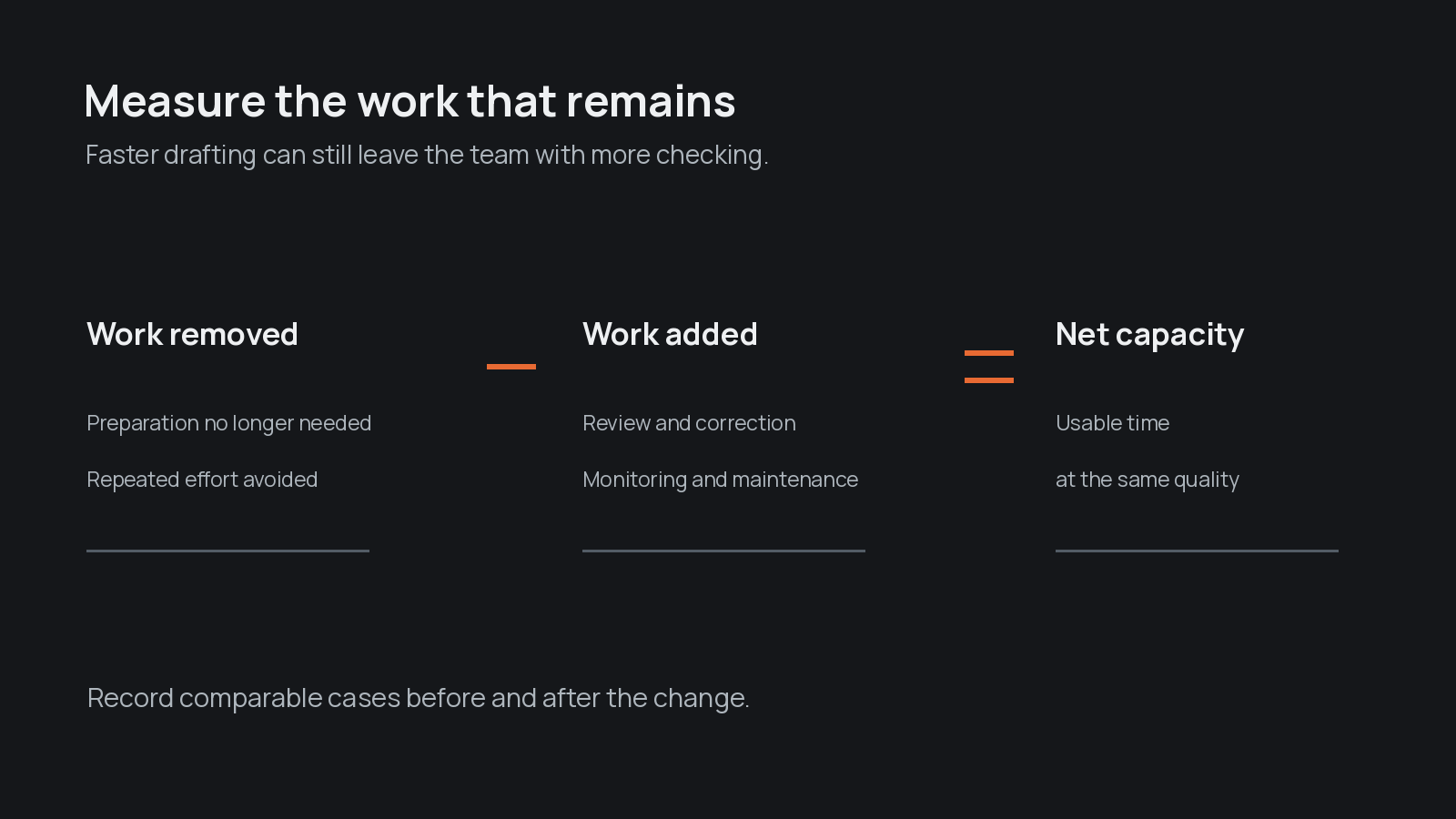
Net AI time savings are the reduction in total human effort after preparation, checking, corrections and maintenance. The time an answer takes to appear tells you little about that total.
Measure the assisted process using the same start and finish points. Include retries, copying between tools, exception handling and downstream repairs. Record recurring maintenance separately so it appears once in the calculation.
For AI workflow review, track acceptance without correction, serious errors and owner interruptions alongside time. A draft can arrive sooner while needing more supervision. Putting AI in a defined workflow step makes that responsibility easier to test.
OAIC guidance calls for appropriate human oversight and ongoing review. Organisations covered by the Privacy Act must meet accuracy obligations for personal information. Keep required checks in the measurement; our guide to AI around professional judgement explains why approval stays with people.
Separate AI business benefits from cash savings
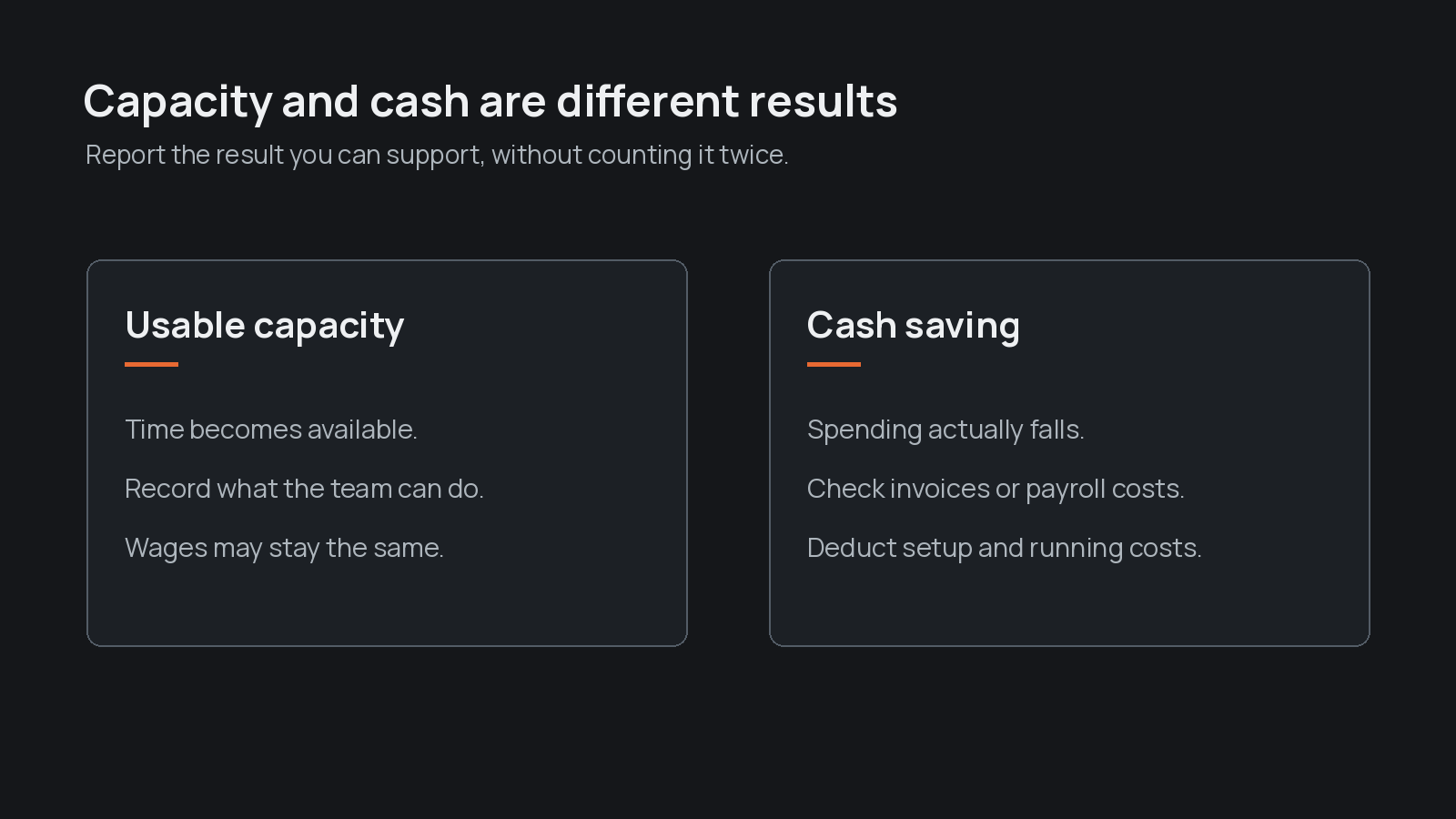
Saved time, cash savings and capacity describe different business outcomes. Report each on its own evidence.
This table distinguishes the benefit from the proof needed.
Benefit comparison
- Saved time: what to record: Less total human effort; financial meaning: Wages may remain unchanged.
- Cash saving: what to record: A cost actually avoided; financial meaning: Lower overtime or supplier spending.
- Capacity: what to record: Extra accepted work completed; financial meaning: Money only when profitable work follows.
NAB's Q1 2026 SME survey findings distinguish reported productivity benefits from profitability and revenue benefits. These are respondents' assessments, rather than proof that AI caused a financial return.
Warning
Please note: Multiplying saved hours by an hourly rate estimates the value of released time. Record cash savings only when spending actually falls. Do not count that same time again as additional revenue without evidence of extra work and its delivery costs.
If relief is the goal, record fewer after-hours checks or questions that need the owner. Keep that evidence alongside financial results.
Use this worksheet to measure AI results
A measurement worksheet should produce both a net-time result and a financial result for the same period. Use the printable AI results measurement sheet or copy these fields into a spreadsheet, then attach the task log and invoices.
- Task, measurement dates, owner and definition of acceptable completion: ____
- Comparable jobs completed, with difficult jobs and failures identified: ____
- Baseline human minutes per job, including preparation, review and corrections: ____
- Assisted human minutes per job, including those same steps and retries: ____
- Recurring maintenance hours outside individual jobs: ____
- Setup cash paid and setup staff hours, including training and data preparation: ____
- Ongoing cash costs: licences, usage, support, connections and other charges: ____
- Quality results, serious errors and owner interruptions before and after: ____
- Cash actually avoided; extra contribution after delivery costs; intended use of released time: ____
- Decision thresholds, review date and person authorised to stop the trial: ____
Calculate net hours released as jobs multiplied by the difference in minutes per job, divided by 60, less recurring maintenance hours.
Illustrative arithmetic only: 40 comparable jobs taking 18 minutes manually and 10 minutes with AI release 320 minutes. Subtract 60 minutes of maintenance to leave 260 minutes, or about 4.33 hours. These are hypothetical inputs, not a client result.
For a cash view, subtract ongoing cash costs from verified avoided spending and extra contribution. For an operating-value view, value released hours at a documented internal rate and subtract ongoing cash costs. Count maintenance labour separately only if it was not already deducted. Label this as estimated capacity value.
Show setup cash and staff-time value separately, then deduct them when reporting cumulative net operating benefit since the start. Our AI cost guide helps check scope and ongoing charges.
Decide what to continue, change or stop
Continue an AI workflow when accepted work improves, ongoing benefit exceeds ongoing cost, and required controls hold. Check whether cumulative benefit is recovering setup costs over your chosen evaluation period.
Change a workflow when useful output survives but preparation, corrections or maintenance consume the benefit. Investigate the costly step, adjust it and compare again. Workflow friction belongs in the task log.
Stop when errors create unacceptable harm, necessary oversight is unavailable, or repeated tests fail your agreed benefit threshold. Past setup spending is already spent; judge further spending on expected future benefit.
The National AI Centre's monitoring guidance connects performance measures to business targets and regular reviews. Measure AI results again when workload or review requirements change. Assign someone to own the AI decision, and compare a simpler template or process change, as its opportunity guidance recommends.
Make the next decision from evidence
Keep the task log, quality checks and cost record together. They should show what work disappeared, what checking remains and whether the team can use the released time. We help lean teams connect workflow, information and responsibility before they expand AI. Start the next review with those records, rather than the speed of a draft.
Frequently asked
- How do we measure AI results without a financial dashboard?
- Choose one repeatable task, log total human time before and after AI, and record quality and recurring costs for the same period. Use the worksheet to calculate net hours released and keep the cash result separate.
- Do saved staff hours count as cash savings?
- Saved hours release time or capacity. They become cash savings when spending actually falls, such as reduced paid overtime or supplier costs. A staff hourly rate gives an estimated value of released time, not proof of money saved.
- Should setup costs determine whether we keep using AI?
- Include setup cash and staff time in cumulative project results. For the decision to keep spending, compare expected future benefits with future costs and acceptable risk. Past spending alone is not a reason to continue.