Operating Intelligence
Management Buyout or Staff Handover: Move Decisions First
A management buyout works when the managers buying in can already make the calls you make today. Move those decisions to them first, and the ownership question becomes the easier part of handing the business to your team.
The usual plan runs the other way round. The price, the structure and the timing get settled, the shares change hands, and the new owners still ring you about every client exception. The ownership has moved, and the judgement has stayed with the person who was meant to be leaving.
If you want to step back without selling to an outsider, whether through a buyout by your managers, a family successor or keeping the shares and handing over the running, this guide sets out the order in which decisions should move and how to test whether the handover has held.
What are your options for handing the business to your team?
There are three inside routes, and many owners combine them. Each one needs the same thing underneath: people who can run the business without checking with you.
- A management buyout: a sale in which the people who already manage the business buy some or all of it from you, often in stages over several years.
- A family successor: a family member takes over the running of the business, and often the ownership later.
- An owner-only role: you keep the shares and hand the day-to-day running to a manager or a small leadership group.
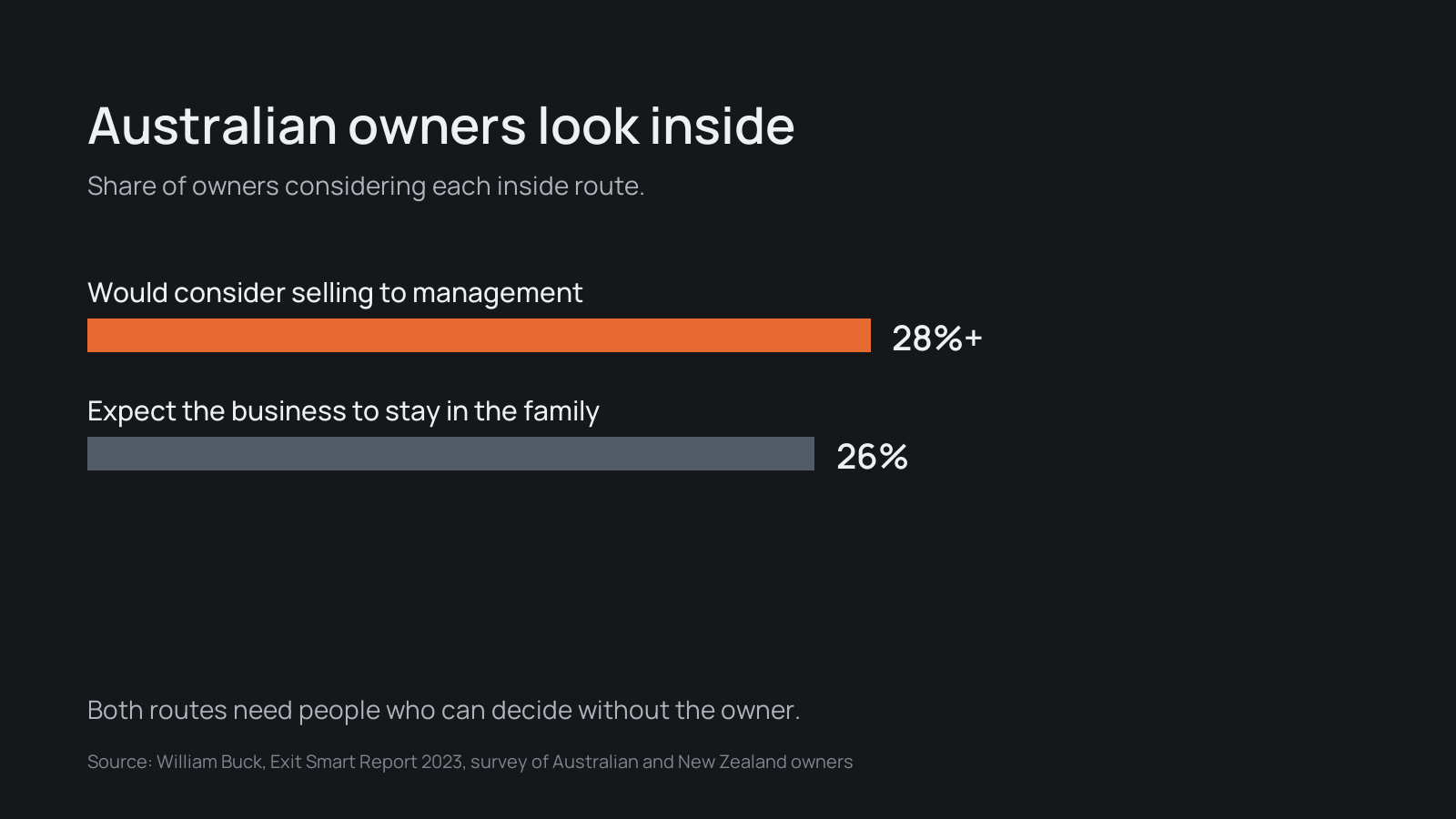
Australian owners do look inside. In William Buck's Exit Smart Report 2023, a survey of Australian and New Zealand owners, more than 28 per cent said they would consider selling to management, and 26 per cent expected the business to stay in the family. Family is a less certain route than it was: NAB's Beyond the Business research in 2025 found that fewer than four in ten owners expect their family to take over.
A buyout by staff is rarely a single transaction. Employee Ownership Australia notes that staff successions usually transfer the business in a graduated fashion over time, and that Australia has little tradition of, or institutional support for, employee buyouts. A staged sale keeps you connected to the business for years, which is why the order in which decisions move matters so much.
Note
Please note: each route carries its own tax, legal, employment and financing questions. Bring your accountant and lawyer in early, before you agree anything with your team.
Our guide to business succession planning separates the ownership, management and continuity questions. This article deals with the part every inside route shares: moving the decisions.
Why is stepping back harder than selling to an outsider?
Stepping back is harder because you are still reachable. When you sell to an outsider, you leave, and the team works out the answers without you. When you stay on as owner, family member or adviser, the questions keep finding you.
Many owners will take the gradual route. NAB's 2025 research found that 46 per cent of small and medium business owners expect to be working in some capacity after they turn 67, most for financial reasons. Nearly half (47 per cent) of small business owners are already aged 50 and over, according to the Australian Small Business and Family Enterprise Ombudsman, and that share has risen at every Census since 1996.
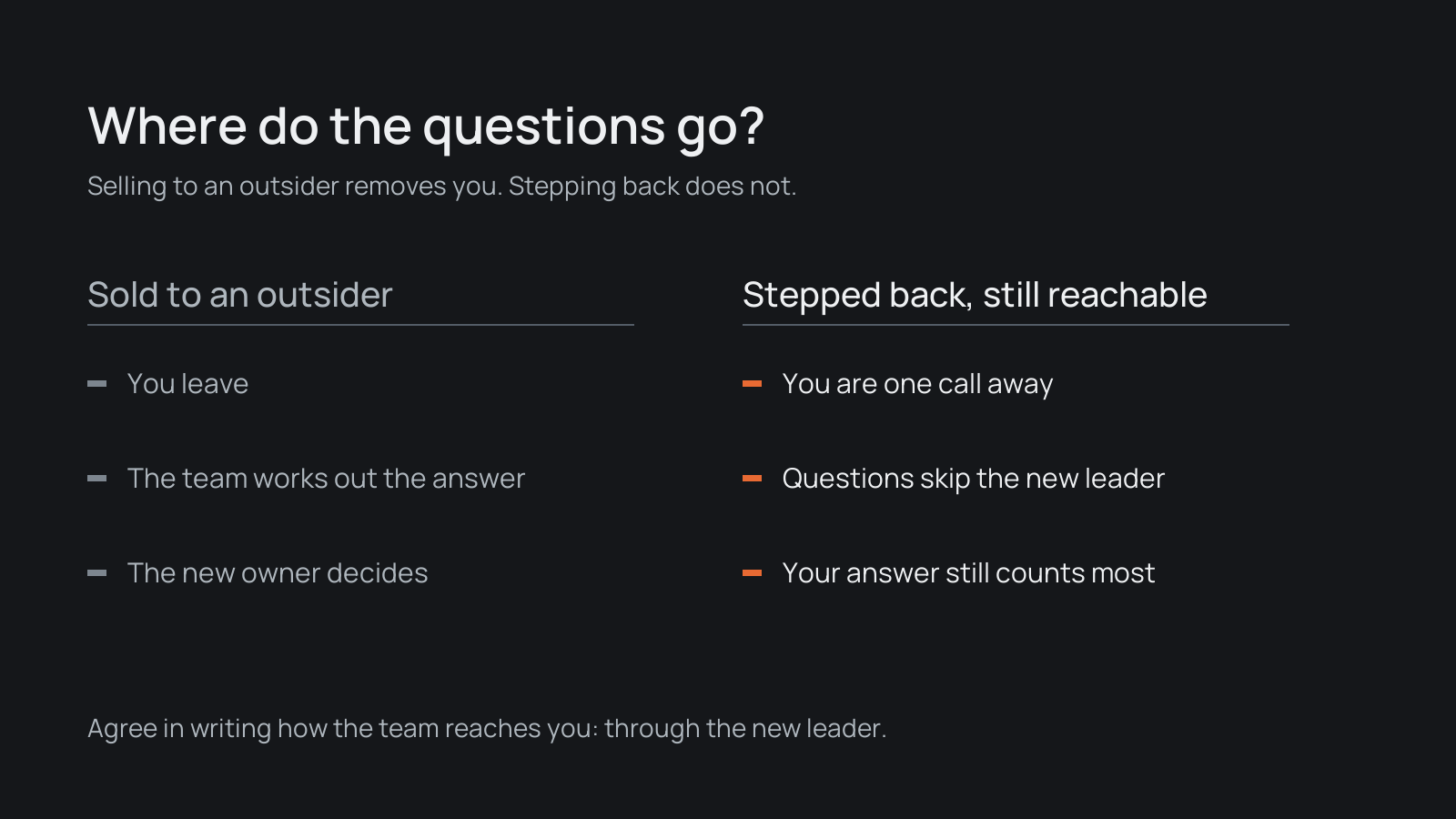
Each time you answer a question the new leader should have answered, the team learns that your answer is the one that counts. After a few months of that, the business has two people in charge, and staff and clients know which one to ask.
Which decisions does your team need that a job description leaves out?
Your team needs the calls you make, and the reasons behind them. A capable manager can already run the jobs, the rosters and the reporting. What they usually lack is the judgement behind those tasks, which has never been written down because it never had to leave your head.
Those calls tend to fall into five groups:
- Pricing exceptions: which clients get a discount, a payment plan or a fixed fee, and why.
- Client flexibility: which clients get a phone call instead of an email, and which deadlines can move.
- Saying no: the work you turn down, the clients you would not take on again, and the reasons.
- Supplier and partner relationships: who gets paid early, who gets the first call when something goes wrong, and what you have promised them.
- People decisions: who is ready for more responsibility, and what you have told staff about their future.
In the same William Buck survey, more than 40 per cent of owners were worried about finding a buyer, and a similar share thought their business was heavily reliant on its current owners. That reliance sits in calls like these, and a share transfer leaves it exactly where it was. This is the problem we work on at Catalyst Systems: what a business earns often lives in one person's judgement, and it only moves when the reasons behind that judgement are captured and handed over.
In what order should decisions move before a management buyout?
Move the decisions that carry the least risk first and transfer ownership last. We call this a decision-first handover: authority to decide moves to the new leaders in stages, from the calls easiest to reverse to the hardest, and the shares follow once the decisions already sit with them. Each stage gives the new leaders practice before the stakes rise, and gives you evidence that the previous stage held.
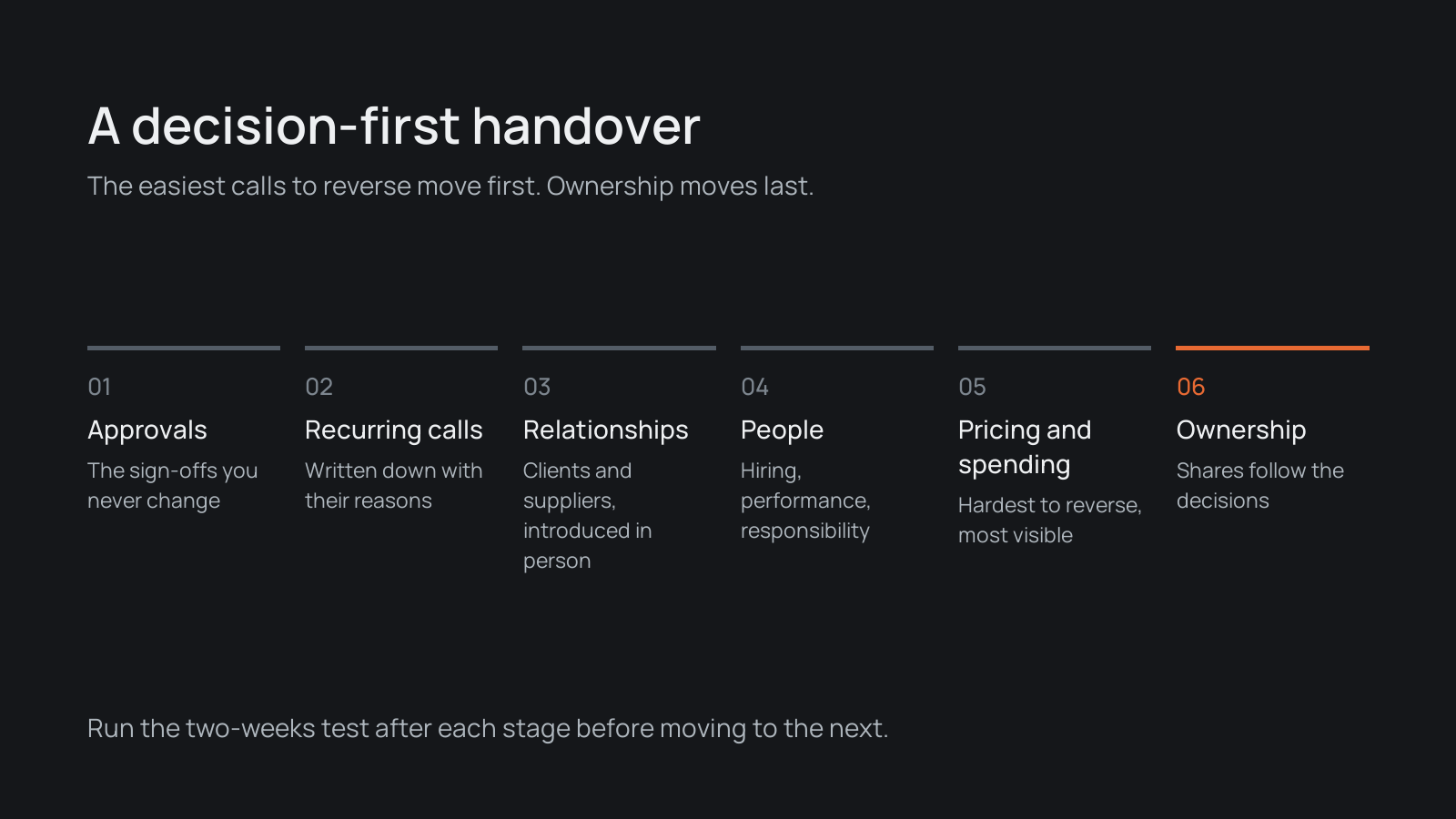
- Approvals you already rubber-stamp. If your team prepares the quote and you sign it without changes, give them the authority. A delegation of authority matrix is a short table that sets out who can decide what, within which limits.
- Recurring judgement calls, with their reasons. Write down the calls that keep coming back to you and why you make them the way you do. A decision log records each decision with its reason and evidence, so the new leader can apply it to a case you never saw.
- Client and supplier relationships. Introduce the new leader in person and tell clients who now makes the call. Then send the next request to that person, even when the client asks for you.
- People. Hiring, performance and who gets more responsibility move next, with you available as a sounding board for an agreed period.
- Pricing and spending. These come late because they are the hardest to reverse and the most visible to clients. A discount given once becomes the price the next client asks for.
- Ownership. By the time shares or control change hands, the people taking over are already making the decisions, and the price and terms reflect a business that runs without you.
Our founder handover guide covers which parts of your knowledge to hand over first. The order above is about authority: who is allowed to decide, and when that changes.
What role do you keep once the decisions move?
You keep the role you agree in writing before the decisions move, and nothing more. Letting go can be hardest for the owners who care most about the team they built. In a study of 34 technology founders published in the Academy of Management Journal in 2016, Elizabeth Rouse found that founders who saw their company as worth sustaining removed themselves from central decision-making so others could run it, and still described leaving as a time of sadness, loss and pain. As one founder put it, "you are not surprised, but still, it's a loss."
Those founders were leaving start-ups rather than established small businesses, but the risk carries across. An owner who feels the loss is more likely to drift back in, answer one question, then another, and slowly undo the handover.
Write down three things before the first decision moves:
- What you will still decide, if anything, and for how long.
- How the team reaches you, through the new leader rather than directly.
- What you will not be asked about, so the team knows to decide without you.
Tip
Tip: when a staff member brings you a question that now belongs to the new leader, send them back to that person, and tell the new leader you did.
How do you know the handover to your team has worked?
The handover has worked when the team makes a hard call, the client accepts it and you hear about it afterwards. A business that runs without you only while nothing goes wrong has not been tested yet.
The two-weeks test is a practical check: what breaks if you take two weeks off? Run it after each stage of the handover, and look for these signs over a few months:
- A pricing exception or a client complaint was settled by the new leader, and you found out later.
- Clients now contact the new leader first, including the clients who used to insist on you.
- The team disagreed about something and resolved it without asking you to choose.
- A new kind of request arrived and the new leader decided it by applying the reason behind an earlier call.
If a call keeps coming back to you, the reason behind it has not moved yet. Write that reason down and hand it over, because making the call yourself one more time teaches the team to bring you the next one.
This is the work Catalyst Systems builds for. Clearly captures what happens, connects what the business knows and gives people the context to make better judgements, so the reason behind a past decision is there when the new leader needs it, whether or not you are in the room.
Which decision should you hand over first?
Pick one decision your team brings to you every week and hand it over properly: the authority, the reason behind it and the limits. Then watch what happens the next time it comes up.
Each decision that moves makes the business less dependent on you, whichever route you choose in the end. It also tells you early whether the people around you want to take it on. Find that out before anyone talks price.
Frequently asked
- What is a management buyout?
- A management buyout is a sale in which the people who already manage a business buy some or all of it from the owner, often in stages over several years. The funding and structure vary a great deal, so an owner considering one should get advice from an accountant and a lawyer before agreeing terms with the team.
- Can I step back from my business without selling it?
- Yes. You can keep the shares and hand the day-to-day running to a manager or a small leadership group. It works when the decisions you make today have moved to them, and when you have agreed in writing what you will still be asked about and how the team reaches you.
- How long does it take to hand a business over to staff?
- William Buck advises owners to start planning an exit at least three to five years before they expect to leave, and an inside handover usually sits at the longer end because the sale is often staged. The more useful measure is how many calls still come back to you each week: when that number is close to zero and the team has handled a hard decision without you, the handover is nearly done.
- What if nobody in my team wants to take over?
- Then you have learned something important early, before anyone has negotiated a price. The work of moving decisions out of your head still pays off, because a business that runs without its owner is easier to sell to an outsider, easier to hand to family and easier to step back from.