AI Consulting
How to Choose an AI Consulting Company in Australia
Finding the right AI consulting company Australia has to offer should begin with evidence about your work, data and risks. A polished demonstration says little about whether a provider can improve a live workflow safely.
Define one business problem, ask each provider to diagnose it, compare their evidence and agree on ownership before any build begins. This guide evaluates provider types and selection evidence. Catalyst Systems is excluded from the comparison set.
What should an AI consulting company do before recommending a solution?
A capable AI consulting company should study the work before recommending software. The provider should identify the decision or task to improve, the people involved, the information used, the current failure points and the outcome that will show progress.
That discovery may include interviews, observing the workflow and creating a business process map. The result should describe what happens now and define a narrow first use case. A product recommendation made before that work lacks a reliable basis.
The National AI Centre says the same AI tool can create different risks depending on how it is used. Its essential AI practices recommend reviewing each use on its own and recording decisions, testing, incidents and monitoring. Ask the provider to show how those activities appear in the proposed work.
How do you evaluate an AI consulting company Australia-wide?
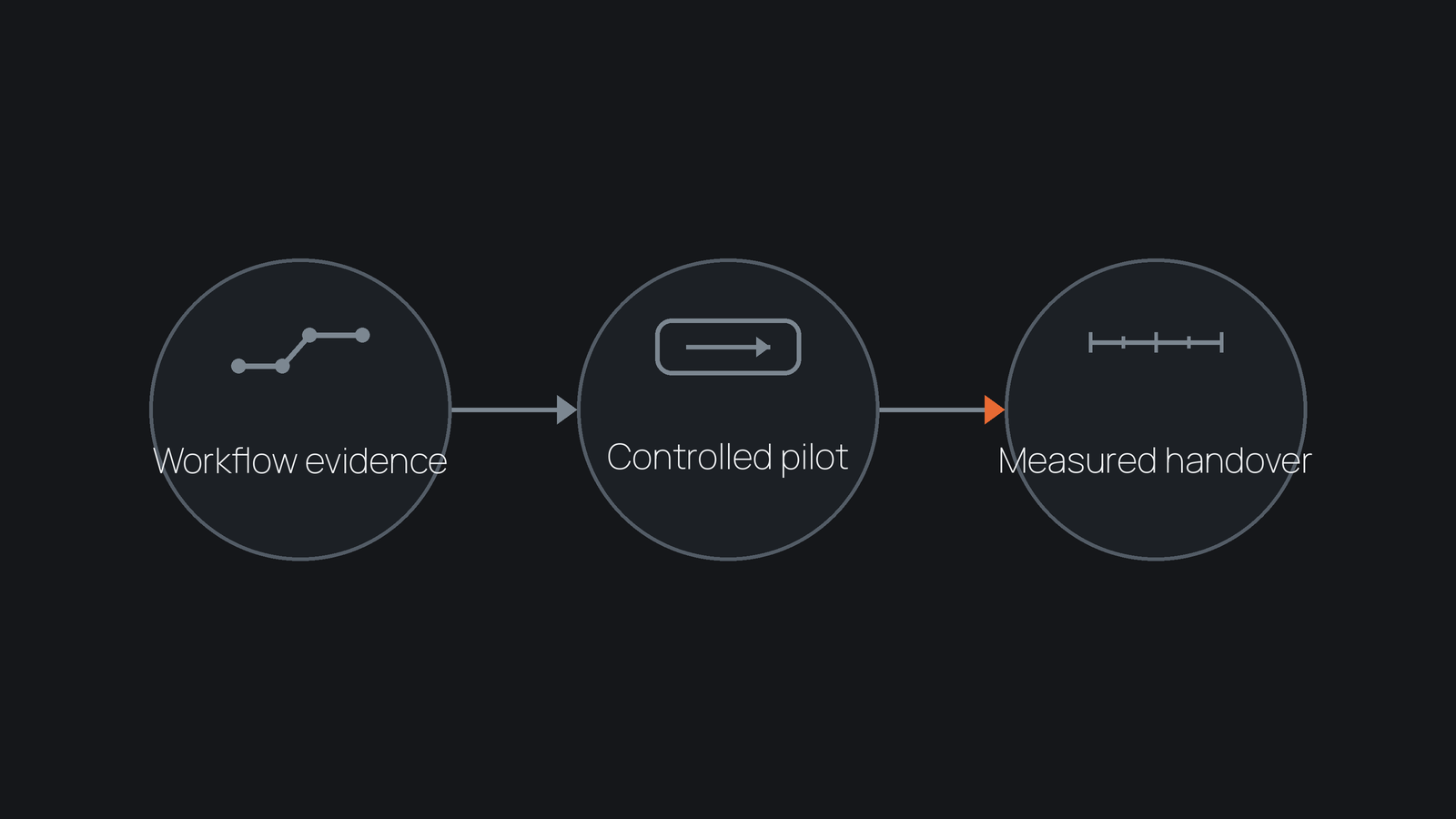
To choose an AI consulting company Australia-wide, evaluate diagnosis, relevant proof, risk controls, build capability and handover. Score the evidence supplied, rather than the confidence of the presentation.
Criterion comparison
- Diagnosis: evidence to request: Current-work map and defined use case; warning sign: Recommendation precedes discovery.
- Proof: evidence to request: Comparable problem, test or reference; warning sign: Generic demonstration only.
- Risk: evidence to request: Data map, human checks and incident path; warning sign: Security handled later.
- Delivery: evidence to request: Pilot scope, owner and success measures; warning sign: Open-ended build.
- Handover: evidence to request: Documentation, training and exit terms; warning sign: Ongoing dependence is assumed.
Relevant proof comes from a similar problem, risk level or workflow. Ask what failed in previous work, what changed after testing and which claims the provider can demonstrate. If you need deeper operational diagnosis, compare the role with a business process consultant before choosing a technology-led provider.
Accountability: Your business remains responsible for how AI is used. The National AI Centre calls for clear ownership across internal teams, contractors and third-party providers, including testing, human oversight and issue handling.
AI consultant vs automation agency: which fits the work?
An AI consultant is usually the better fit when the problem is uncertain, crosses several roles or needs judgement about data, risk and work design. An automation agency is usually the better fit when the process is stable, the rules are known and the job is to connect existing tools.
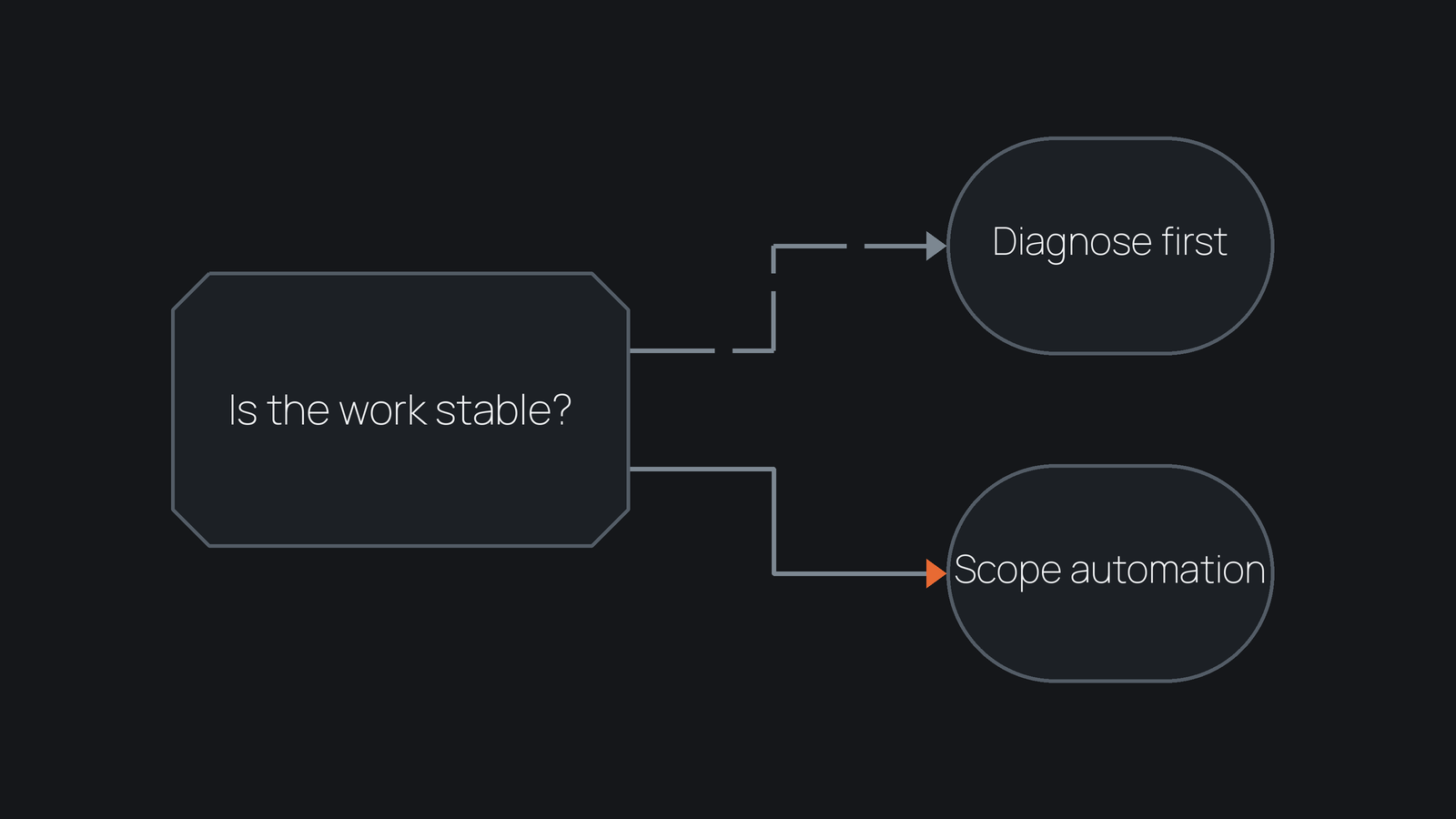
Choose an AI consultant when you need to decide what should change. Choose an automation agency when you already know what should be built. Some providers do both, so assess the method rather than the label. Our guide to AI workflow automation explains the workflow questions worth resolving first.
For either provider type, define a contained first phase. A phase-one AI automation scope should name the workflow boundary, required information, human review points, success measures and stop conditions.
What privacy and security evidence should you request?
Privacy and security evidence should describe where information goes, who can access it, how long it is retained and what happens when something fails. Answers should name the services and responsibilities involved.
The OAIC guidance for commercially available AI products tells organisations to assess intended-use testing, human oversight, privacy and security risks, and access to personal information. It also recommends regular review.
Cyber.gov.au divides secure AI development into design, development, deployment, and operation and maintenance. Ask which party owns access control, logging, updates, incident response and supplier review at each stage. The voluntary NIST AI Risk Management Framework is another useful reference for checking whether a provider manages risk across design, use and evaluation.
Practical due-diligence checklist
Use this checklist before signing a proposal:
- [ ] Write one outcome and one workflow boundary in your own words.
- [ ] Ask the provider to explain the current workflow back to you before proposing tools.
- [ ] Request a named internal owner and a named provider owner.
- [ ] Inspect a pilot plan with test cases, human checks, success measures and stop conditions.
- [ ] Confirm where business and personal information will be stored, processed and retained.
- [ ] List every third-party service that can access your information and review its terms.
- [ ] Agree on access controls, logs, monitoring, updates and incident notification.
- [ ] Confirm who owns documents, configurations, prompts, integrations and other deliverables.
- [ ] Require a handover plan covering training, documentation, maintenance and exit support.
- [ ] Speak with a relevant reference or inspect equivalent evidence with confidential details removed.
The Department of Industry's AI Adoption Tracker methodology says the tracker collects 400 completed SME surveys each month and records responsible practices such as output checks, staff training and customer-data protection. A national trend cannot choose your use case. Your workflow and risk determine the right provider.
When is an AI consultant unnecessary?
An AI consultant is unnecessary when the problem and solution are already clear, the work is low risk and someone inside the business can own the result. Examples include enabling an approved feature, setting up a simple rule-based automation or training staff on a tool your business has already assessed.
Outside advice also adds little when the business has not agreed on the process to improve or cannot provide a responsible owner. Start by clarifying ownership through who owns AI in your business and checking readiness with an AI readiness assessment guide. A business-focused AI consultant becomes useful when the work requires independent diagnosis, choices across several systems or a controlled path from trial to daily use.
Choose on evidence you can keep
The right provider leaves your business with a clearer workflow, named accountability and evidence that the solution works under real conditions. Begin with one bounded problem, score each provider against the same criteria and make handover part of the agreement from the start.
Frequently asked
- What questions should I ask an AI consulting company?
- Ask about the business outcome, workflow discovery, information requirements, testing, risk ownership and handover. Request evidence for each answer.
- Should an Australian AI consultant understand the Privacy Act?
- A provider handling personal information should identify relevant privacy obligations and know when specialist privacy or legal advice is required.
- Do I need an industry specialist?
- Industry experience matters where regulation, terminology or work practices affect the use case. Comparable workflow and risk experience may be enough for lower-risk internal work.
- How many providers should I compare?
- Compare enough providers to test different approaches, using the same written problem, evidence requests and scoring criteria for each.