Operating Intelligence
Business Exit Planning: Remove Founder Dependency Before You Sell
Business exit planning is the work of preparing an owner, business and successor for a transfer of ownership or control. For a founder-led company, its hardest test is simple: will the value continue when the founder is no longer doing the remembering, deciding and reassuring?
A buyer can acquire contracts, assets and a brand. They cannot acquire the founder's memory by assumption.
If major clients call only the owner, exceptions wait for the owner's judgement and staff cannot explain why decisions were made, the business may earn well today but transfer poorly. Exit planning must turn that personal capability into an operating capability before due diligence exposes the gap.
Start before the sale process
The Australian Government's succession planning guidance says not to leave planning until the last minute. It recommends choosing a successor, valuing the business, documenting policies and processes, planning for a sudden transition and keeping the plan current.
That work takes time because founder dependency is rarely one missing procedure. It is a pattern built over years: the owner resolves unusual cases, knows which customer promise matters, carries supplier history and notices risks before anybody else.
Begin while there is enough time to test whether the business can operate differently. This improves options whether the eventual path is an external sale, family succession, management buyout or a gradual reduction in the founder's role.
Our guide to reducing founder dependency explains why the goal is not to remove judgement. It is to make the evidence, context and decision rights available to the people who need them.
Find where the founder still carries the business
Review dependency across four areas.
Decisions
Which pricing, hiring, service, risk and customer decisions return to the founder? Separate decisions that genuinely require owner authority from those returning out of habit or because criteria are unclear.
Relationships
Which clients, suppliers, referrers and advisers trust only the founder? Record relationship history, current commitments, commercial sensitivities and the next appropriate owner. A contact list is not a relationship transfer.
Knowledge
What does the founder know about quality, exceptions, past failures and the reasons behind policy? Procedure documents capture the normal path. Buyers and successors also need the judgement around the edge cases.
This is the same risk described in knowledge management when key people leave. The problem is not merely missing files. It is missing operating context.
Access and authority
Which bank permissions, software administration, licences, contracts, passwords or approvals depend on the founder? Key person risk becomes immediate when nobody else can act during an absence.
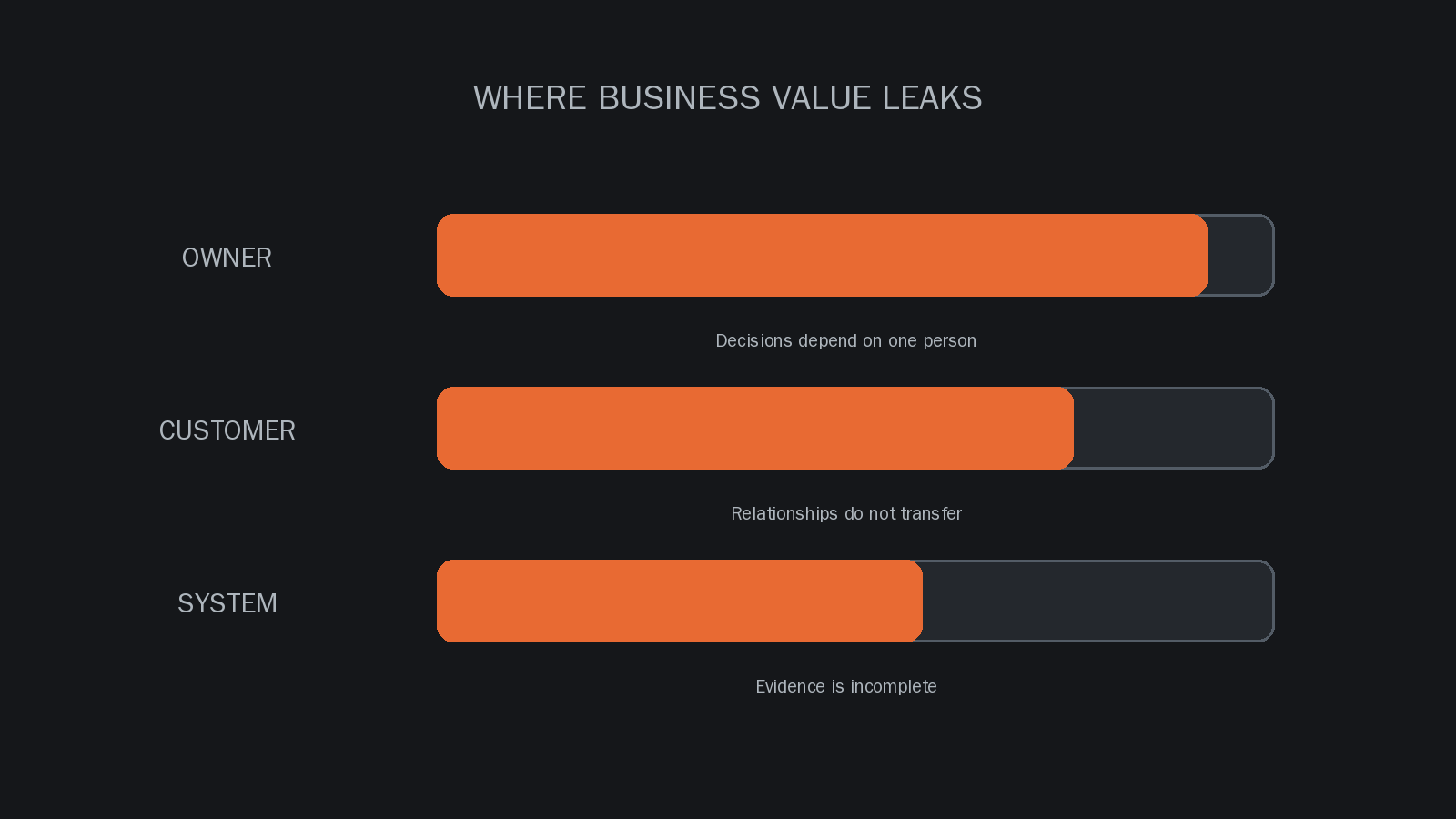
Create a register with the dependency, consequence, current backup, evidence required and target owner. Rank items by effect on revenue, customer trust, compliance and continuity.
Build a business a buyer can examine
A buyer will test claims about maintainable earnings and transferable operations. Business.gov.au's valuation guidance recommends organising financial statements, legal documents, procedures, plans, staff information, supplier details and customer information. It notes that future profit is a major source of value to a buyer.
Clean records reduce uncertainty. Prepare a controlled evidence set covering:
- normalised financial results and forecasts
- recurring and concentrated revenue
- customer and supplier agreements
- employee roles, entitlements and dependencies
- intellectual property ownership
- leases, licences, insurance and material obligations
- documented processes, controls and performance measures
- known disputes, risks and exceptions
Do not manufacture certainty. Record where information is incomplete, who is correcting it and when it will be ready. In its guide to selling a business, business.gov.au warns that information provided during negotiation must be accurate and not misleading.
Documentation should show how the business works, not create a shelf of procedures nobody follows. Systemising a small business means giving repeat work clear ownership, inputs and exceptions without adding unnecessary complexity.
Transfer decisions before transferring shares
Start moving routine authority to the people who will carry it after the exit. For each decision category, define:
- who decides
- the limits of their authority
- the information they need
- when they must escalate
- where the reason and outcome are recorded
Use real cases to calibrate those rules. Ask the founder to explain not only the answer, but the signals that changed the answer. Examples of approved and rejected cases often carry more judgement than a long policy.
Relationships need staged transfer too. Introduce the new owner of the relationship while the founder is still present, then let that person lead routine contact. Track whether information and trust flow to the role rather than returning privately to the founder.
Business.gov.au recognises business procedures, customer relationships, staff performance and goodwill as relevant intangible value. Transferability does not guarantee a valuation outcome, but dependence on one person gives a buyer more uncertainty to price.
Run the business without the founder before a buyer does
The clearest test is a planned absence long enough for normal work and exceptions to occur.
Before the test, define what the founder will not do, who holds each authority, how genuine emergencies escalate and what evidence will be reviewed afterwards. Do not secretly rescue the process through private messages.
Measure:
- decisions that waited or returned to the founder
- customer and supplier escalations
- missed commitments
- access failures
- rework and delays
- exceptions with no owner
- information people could not find
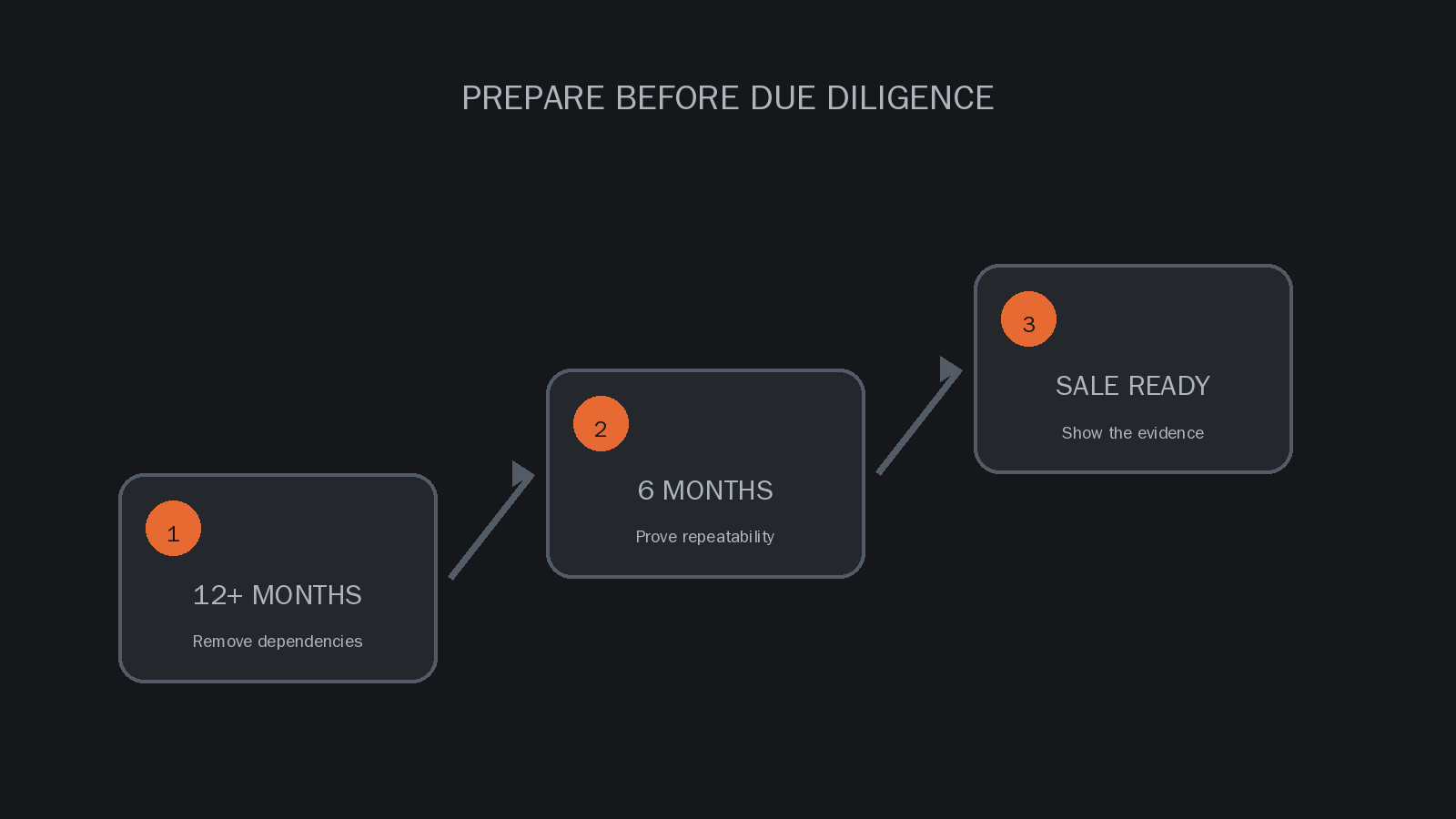
Use the findings as an exit-readiness backlog. Repeat the test after correcting the highest-consequence gaps. A useful companion is the two-weeks test inside our founder handover guide, which asks what would stop if the founder disappeared from the workflow.
The Australian Taxation Office advises private groups to put a succession plan in place, review it regularly, document transactions and consider valuations and tax consequences in its succession planning guidance. Legal, tax and valuation advice should run alongside the operating work, not arrive after a buyer is found.
Make value transferable
Business exit planning should leave the founder with options and the successor with a business they can actually run. That requires more than a sale timetable.
Find the decisions, relationships, knowledge and access still concentrated in one person. Create evidence a buyer can examine. Move authority in controlled steps. Test the business during a real founder absence, then repair what returns.
The work is complete when the founder's capability has not vanished, but has become usable by the business. That is what makes continuity credible and value more transferable.